
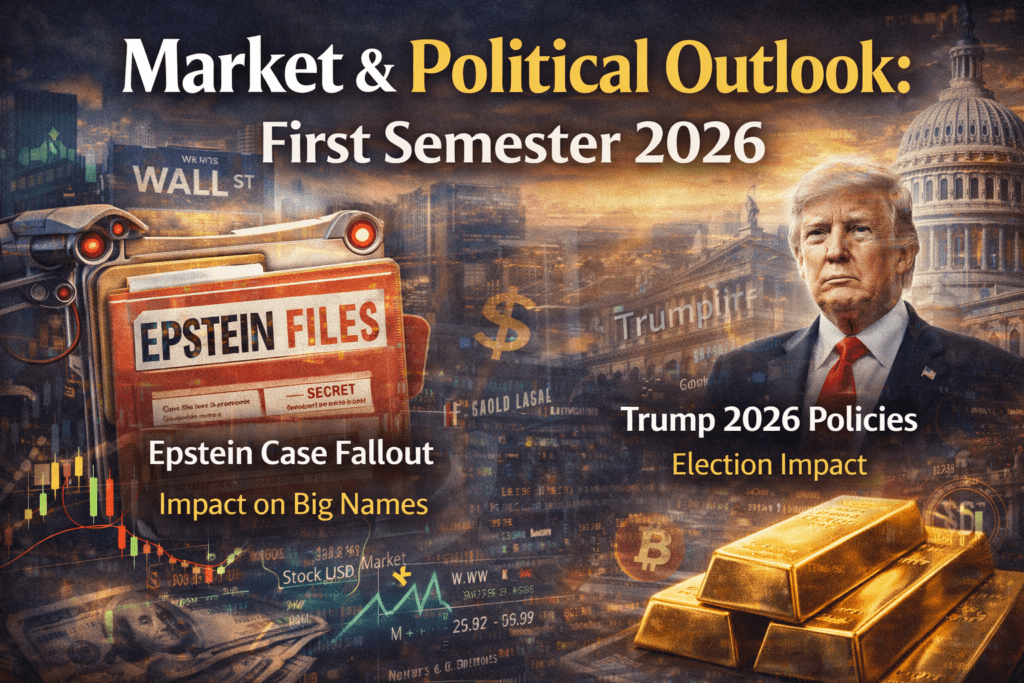
Introduction: Why Politics Matters More Than Ever in 2026
The first semester of 2026 opens with markets highly sensitive to political risk, public trust, and narrative-driven volatility. Beyond traditional macro factors like inflation and interest rates, investors are reacting to:
- Political positioning ahead of key elections
- Policy expectations tied to Donald Trump’s agenda
- Renewed attention on high-profile legal and political cases
Markets are no longer driven purely by data — perception and confidence play a growing role.
Macro Backdrop: A Fragile Confidence Environment
At the macro level, investors are navigating:
- Slowing but uneven global growth
- Sticky inflation in key economies
- Central banks that remain cautious and data-dependent
This creates an environment where headline risk can override fundamentals in the short term.
Political Risk as a Market Driver
The Return of Political Volatility
Political developments increasingly act as volatility catalysts, particularly in:
- Equity indices
- Safe-haven assets
- Currency markets
Even without immediate policy changes, expectations alone are enough to move markets.
Trump’s Policy Direction and Market Expectations
Donald Trump’s renewed political influence has refocused attention on several themes markets are closely watching:
- Trade and tariff rhetoric
- Fiscal spending and taxation priorities
- Deregulation vs. institutional stability
Market Impact
- Equities: Cyclical sectors react quickly to policy expectations
- USD: Sensitive to fiscal outlook and geopolitical tone
- Gold: Benefits from uncertainty and policy unpredictability
Markets trade anticipation long before policies become reality.
High-Profile Legal and Political News: Confidence Shockwaves
Renewed attention on controversial political and legal cases has contributed to:
- Short-term spikes in volatility
- Rotations into defensive assets
- Increased demand for transparency and accountability
From a market perspective, the key issue is not the details themselves, but how such news:
- Affects public trust
- Impacts institutional confidence
- Fuels risk-off sentiment
Asset-Class Outlook: First Semester 2026
🟡 Gold (XAUUSD)
Gold remains a key beneficiary of political uncertainty.
Drivers:
- Real yields
- USD direction
- Risk sentiment
Outlook:
- Strong demand during periods of political stress
- Pullbacks viewed as potential accumulation zones
📈 Equity Markets
- Indices remain supported by liquidity
- Political headlines may trigger sharp but temporary corrections
- Sector rotation likely throughout the semester
Volatility does not mean bearish — it means selective.
💱 Forex Markets
- USD reacts strongly to political and fiscal narratives
- Safe-haven currencies benefit during risk-off phases
- Range-bound behavior expected outside major headlines
₿ Crypto Markets
Crypto remains sentiment-driven.
Key influences:
- Risk appetite
- Regulatory tone
- Correlation with tech equities
Political uncertainty often leads to short-term volatility spikes rather than sustained trends.
Key Risks to Monitor in H1 2026
- Unexpected political statements or policy shifts
- Escalation of legal or institutional uncertainty
- Sudden changes in fiscal expectations
Traders and investors should remain flexible and avoid overexposure to single narratives.
Strategy Takeaways for Traders and Investors
✔ Expect headline-driven volatility ✔ Prioritize risk management ✔ Avoid emotional reactions to political news ✔ Focus on confirmation, not speculation
In politically charged markets, discipline becomes a competitive advantage.
Frequently Asked Questions (AEO Optimized)
Why do political events move markets so quickly?
Because markets price expectations, not outcomes.
Is gold a hedge against political uncertainty?
Historically, yes — especially during confidence shocks.
Should long-term investors worry about short-term political noise?
Only if it alters long-term fundamentals.
Final Thoughts
The first semester of 2026 is likely to be defined less by economic surprises and more by political narratives and confidence cycles.
Investors who understand how news translates into market behavior — rather than reacting emotionally — will be better positioned to navigate volatility.
Leave a Reply